

If your stand exceeds 4 m in height it will be deemed as a complex stand. Check more information on complex stands below.
Inside the halls, the maximum stand height is 6m tall. You are permitted to have rigging but it should not exceed 8m tall. This is measured from the venue floor to the top of the banner / truss.
Location | Inside Halls 1, 2, 3 and 4 | Stands next side pillars inside Halls | Between Halls 1/2 and 3/4 | Between Halls 2/3 | Sony Square - Affiliate Leaders | FIL Square |
Height Restrictions (including platform) | 6 metres | 3 metres | 3.5 metres | 2.5m - 3.5m | up to 4 meters. Restrictions apply depending on location | 3.5 metres |
Stands which meet any of the following will be deemed Complex, these require additional sign off by an independent certified engineer and payment of the Complex Stand Plan Submission Fee.
Stands with a height greater than 4 metres.
Double decker and multi-storey stands with two levels that people can access (Only Permitted on island stands and inside halls 1, 2, 3, and 4)
Stages with a height equal to or higher than 500mm. Check more information in Platforms/Ramps.
Tiered Seating, lighting towers and rigs, suspended structures, marquees and tents, pedestrian and crowd barriers, inflatables, stands subject to external wind forces.
Rigged banners: Bespoke metal/timber banner require supporting structural calculations (Lightweight aluminium/fabric style are not complex).
Stands located outdoors—those in FIL Square or between halls 1&2 , 2&3 and 3&4—are exposed to external elements like wind and will be subject to inspection by a structural engineer and associated complex stand fees.
All the above require supporting technical scale drawings, calculations including all dimensions, weight loads, heights, materials to be used etc.
SBC reserves the right to deem a structure ‘complex’ where this has not correctly been determined by the designer. The venue/SBC may authorise the construction of a complex structure in accordance with the regulations established by the venue where the ceiling height and the hall structure allow it.
If using an independent contractor be sure to highlight the maximum loading capacity and plan ahead of the exhibition.
Location | Inside Halls 1, 2, 3 and 4 | Between Halls 1/2 and 3/4 | Between Halls 2/3 | Sony square - Affiliate Leaders | FIL Square |
Floor Loading | 2000 kg/m2 | 200 kg/m2 | 2000 kg/m2 | 1250 kg/m2 | 200kgm2 |
The regulations must be adhered to when designing and building a space only stand, please pass this information onto your contractor:
All mains electrical power works must be carried out by the official event contractor: 4foreverything. Please order power or electrical items via virtual shop.
No hot works and no cutting permitted onsite.
All stands are to be constructed so as to pose no danger to public safety and order.
No part of the stand construction, including rotating signs, or any exhibits may protrude into the gangways or over neighbouring stands.
All gangways at the show must be kept clear at all times
Doors cannot not open onto gangways.
Exhibits, furniture and other items belonging to your stand must not encroach beyond the boundary of your stand space. This is to ensure that escape routes are unobstructed in case of emergency evacuation.
Maximum capacity for enclosed rooms is 60 people with one door. Thereafter, a minimum of two doors are required, sited remotely from each other.
All stand construction must be completely self-supporting and no fittings or painting may be made to any part of the venue structure.
All cladding of columns must be self-supporting and access must be made available to columns at all times
All ground based constructions must be completely free standing. It is not permitted to have any ground based walling supported via the venues rigging points.
Do not attach anything to the fabric of the building and take care when constructing your stand, as any damage caused by paint, stickers, nails, screws, etc, will be charged to you.
Platforms must be of a strength and stability sufficient to carry and distribute the weight of stand fittings and exhibits with regard to the loading limits of the venue floor.
The maximum height of raised platforms is 100mm.
Any platform over 40mm will require to have a ramp incorporated with a minimum 900mm width.
Any stage areas of 500mm and over will be deemed complex and will require structural calculations to be submitted. Area/platform of 500mm and over must have an access ramp within the booth area with a minimum width of 90cm.
Stages under 500mm are not deemed complex but will be reviewed
Any raised platform on your stand should have a clearly outlined edge. The edge needs to be a contrast from the main floor covering in order to be clearly seen.
Any items left in the gangways after 8pm on Sunday 27th September, will be treated as waste and disposed of. Any items that need to be kept in the halls must be stored on your stand plot.
All stand construction and displays must be made from fireproof materials and installed to the satisfaction of the authorities.
Only fire resistant carpet, reference M3, can be utilised.
- Closed ceiling rooms are permitted as long as they have a fire extinguisher inside
On the roof inside the halls there is a metallic grid allowing the assembly of suspensions and the floor has duly equipped technical gutters.
It is the responsibility of the stand owner to complete walling and not the neighbouring companies responsibility.
Dividing walls must be built between your stand and adjoining stands, extending to the boundaries of your stand.
Walls above 2.5m which overlook adjoining stands must be finished neatly to the satisfaction of the organiser, in a plain and neutral white/black colour with no advertising or branding, so that this does not impose on neighbouring stands.
Open Side Walling. Any open side of a stand space must remain at least 50% unobstructed by solid walls or structures. Solid walling, in this case, is considered as walls over 1.2m height. This requirement ensures clear sightlines across the show floor and supports fair visibility for all exhibitors. Where a larger wall does not adversely impact neighbouring stands or overall visibility, concessions may be granted at SBC's discretion.
All Space Only stands must provide their own solid back wall and/or side wall if they want walling. Use of existing venue wall or neighbouring stand wall will not be permitted.
Wall panels that face open gangways must be decorated with display graphics and not be left plain.
No materials may be fixed to a neighbouring shell scheme stand.
Traps must be cut into platforms to provide access to the electricity and other service boxes in the building floor.
When installing open corners - of stand floors and platforms - these should be splayed, rounded and angled, if not protected by heavy exhibits, to avoid sharp corners and tripping hazards.
Professional scale drawings showing all proposed constructional details must be submitted and approved prior to the build-up of the show.
The use of EPT (Electric Pallet Trucks/Electric Stackers) is strictly prohibited anywhere at the venue.
A method statement, risk assessment and health and safety declaration must be submitted with your stand drawings.
Construction heights are subject to event rules and regulations.
Exhibitors are responsible for any damage caused by the builders.
You are responsible for the actions of any contractor you employ to work for you and will be held responsible for misconduct by them. Any damage caused by your contractors will be charged directly back to you.
SBC reserves the right to cancel any stand construction if plans do not align with venue and/or exhibition regulations. New plans will need to be submitted and approved for construction to resume.
For any questions please contact: sbcgaming@abraxys.com
Double deckers and multi-storey stands are only permitted inside the halls and on island stands.
Sony square - Affiliate Leaders, FIL Square, Between Halls 1&2, 2&3 and 3&4 zones are not permitted double deckers due to height and floor loading restrictions.
Assembly of stands that include the construction of a second floor must have detailed technical drawings and structural calculations.
This should include justification of the vertical and horizontal loading, primary framing members, access staircase, handrails, baseplates and overall stability.
Construction drawing of the structural framing of the stand including the primary stability system, access staircase, handrails, baseplates.
Side Pillars
Side pillars impose a 3 metre height restriction on the stand.
Check the floor plan to see if your stand has pillars next or directly on top. If your stand is directly on top of one of the side pillars in the Halls, please let your stand builder know. It is important to avoid last minute design changes.
Central Pillars and Fire Extinguishers
Stand building next to the central pillars is possible as long as the access to the fire extinguisher is always visible and accessible and the circulation corridors with 3m are also kept.
All central Pillars have fire extinguishers directly next to them.
All fire extinguishers need to be accessible and visible during the build, live and breakdown of the event, in case of a fire emergency.
All stand plans adjacent to central pillars must indicate a clear area in front of the fire extinguisher. A minimum space of 700mm must be left unobstructed. Plans will be rejected if access to the fire extinguisher is blocked.
To request rigging service, complete the stand plan submission form and wait for initial contact from AVK. We encourage to place orders as soon as possible to avoid delays.
Contact AVK for rigging quote or any questions rigging.sbcsummit@avk.pt
The rigging quote provided by AVK is based on the current technical requirements received from the contractor. This plan needs to be approved as part of your full stand submission plan by the H&S provider. If the rigging plan, has to change due H&S requirements, this may require changes in the rigging quote.
Early bird deadline 14th August - After 25% increase
Final deadline 28th August - After Subject to availability
Rigging services are provided exclusively by the venue’s official provider, AVK. The installation and use of rigging systems, including the provision of basic anchoring points, is an exclusive service offered through AVK. This provider is responsible for assessing, installing, and testing all rigging systems.
It is strictly forbidden to attach or suspend any objects directly from the ceilings of the halls or other facilities within the FIL.
The load capacity for each node is clearly marked, and exhibitors must adhere to these limits. The ideal and most cost-effective method is to install rigging points directly at the available nodes, ensuring a maximum load of 80kg - 150kg, depending on location, and not exceeding this limit. However, exhibitors should be aware that the desired points may not always align with the available nodes, requiring adjustments.
Rigging Regulations
Rigging is not permitted between pavilions/halls, sony square (Affiliate Leaders) and FIL Square.
Rigging or hanging banners - of any kind - above your booth is not permitted if the stand is smaller or equal than 25 sqm.
Rigging should be rigged at a maximum of 8m. This is measured to the top of the banner/truss from the venue floor level. Truss heights will be checked via laser-measure. In some cases, the rigging height may need to be lower if pre-rigging is required. If a pre-rig is necessary, AVK will assess and approve the final rigging height on a case-by-case basis.
The maximum weight you can hang from a rigging node is 80kg and up to 150kg depending on location. The load per node must include truss, structures, safety steel, banners, structures, electrical chain hoists and pre-rig.
Exhibitors must distribute their rigging loads in accordance with the available nodes as indicated on the technical rigging plan.
The maximum weight applies to all the Halls/Pavillions.
Rigging directly hung to the structure must follow a structural matrix of a 3x3 meter grid.
Any rigging installations not coordinated with the official provider are prohibited. This includes the use of third-party rigging equipment or attempting to modify existing anchoring points without the explicit consent and involvement of AVK.
You may use the rigging points directly above your stand. If you need use of any points outside your stand area, approval must be obtained from AVK and SBC. In this circumstance there may be a requirement for prior adjustment for the rigging (pre-rigging). This adjustment may entail additional costs that shall be charged to the Exhibitor or their appointed stand contractor.
All banners/rigging must not exceed the dimensions of your stand.
All rigging must be positioned with a minimum of 1m gap from neighbouring stands.
Banners made out of custom/bespoke metal/timber materials require supporting structural calculations.
All materials used must be certified as compliant with European Union regulations.
The number of points depends on each type of structure and the loads specific to each hall. When a hoisting system (electric hoist) is used, an additional safety cable is mandatory and must be used.
Block-and-tackle and manual hoists are forbidden at the venue, only electric hoists can be used.
The exhibitor's equipment is subjected to an on-site inspection, and technical sheets or other information may be requested.
Powered hoist must be anchored to the structure in a vertical position and must be used with slings attached to the structure and a shackle attached to the engine.
The maximum heights for suspended elements indicated by management must be complied with.
All suspended wooden elements must be securely attached to a European Union-approved structure in such a way that the loads are evenly distributed. The anchor points or hoists will be attached to this approved structure.
As well as the structure type and load-bearing capacity of each hall, the distribution of weight throughout the structure must be considered when deciding the number and location of anchor points for suspending it.
Rigged banners with a pre-manufactured lightweight Aluminium frame with a fabric / pvc infill are non complex. If modifications to this rigged banner are made after submission, a review by an engineer must be made and complex fee payment will be charged on site.
All rigging must be reviewed prior to build.
Trusses can either be rented from AVK or provided by the stand builder. Please indicate your preference on the rigging submission form.
Pre-rig truss and hoists are exclusively provided by AVK.
Overhead electrical cables must be rented directly through the 4foreverything Virtual Shop. Please note that AVK does not supply overhead electrical cables for rigging, and they are not included in any AVK rigging quotes.
WHEN CREATING YOUR RIGGING PLAN BE AWARE OF THE AVAILABLE RIGGING POINTS.
Download PDF rigging plans below:
Hall 1 - Download here
Hall 2 - Download here
Hall 3 - Download here
Hall 4 - Download here
The technical floor plan can be downloaded via the following link: technical floor plan if you require a DWG copy, please request from events@sbcgaming.com
Ensure you provide the following details
Structural Calculations by certified engineer to prove the stability of the rigged banners.
Details of any rigging: a description of the elements to be hung, the number of rigging points required, the total weight of the rigging setup, the maximum weight per rigging point, indicate whether you will be providing your own truss or if it needs to be sourced through the official provider.
Detailed load per rigging point if the load exceeds the 10kg kg/m².
A detailed floor plan will be provided, indicating the available rigging points on your stand. The stand contractor will be responsible for selecting the appropriate locations for the rigging setup.
Calculations should validate the structural elements, specifically addressing the spanning members and the total weight assigned to each hanging point.
Lifting tackles should be verified as capable of supporting the weight of the elements.
All lifting points must be clearly indicated in the drawings, along with the load magnitude for each individual suspension point.
3D view of the stand, with visualization of the stand layout, cable drop locations and connections.
Submit your rigging plans in PDF format. These plans should include all necessary details and calculations to ensure safety and proper setup.
Include a weight spreadsheet of the hung element. Example below:
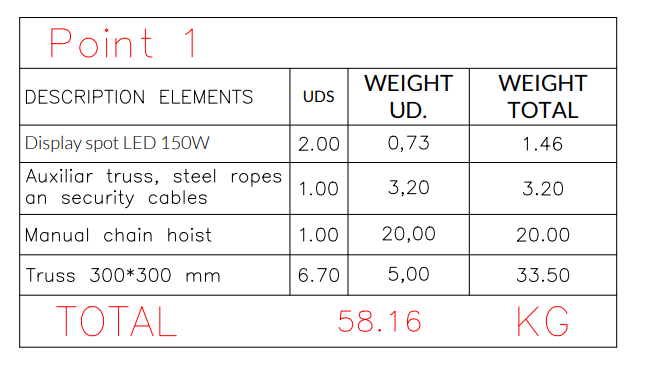
Rigging plans must be submitted in English and use measurements from the International System of Units.
If the plans do not meet the required standards or if any deficiencies are identified, the Organizers may suspend rigging approval until the necessary documentation is provided or the issues are corrected to ensure compliance with safety guidelines.
The contents of this section act as a guide only and are not intended to be a complete statement of law or other regulations.
SBC Events are committed to providing, maintaining and promoting the highest standards of Health, Safety & Welfare at all of our events. All exhibitors and contractors at the event are expected to ensure that they provide a safe place and system of work. Successful safety management requires the commitment, involvement and cooperation of all those on-site at an event.
Following Portuguese law everyone must follow the regulations imposed by Código do Trabalho (Portuguese Working Code). This Regulation contains the provisions by which the government regulates health and safety for workers, time regulation, contracts, labour regulations and employment conditions.
All exhibitors and contractors working onsite during build and breakdown up are required to wear appropriate footwear and a high visibility vest. Please note that those who do not conform with these rules may be refused entry into the venue. Anyone not adhering to these guidelines will be asked to leave the exhibition.
Your Health & Safety Obligations
As an exhibitor, you have a legal duty of care for the safety of anyone who may be affected by your activities. You are ultimately responsible for all aspects of safety on your stand during the buildup, open period of the show and during the breakdown. Where you contract out the building and finishing of your stand you are still vicariously responsible for the activities of your contractors.
Machines and Tools Onsite
The exhibitor shall equip the installations that must function during the event with the protective devices necessary for the work and accident prevention required by the technical regulations defined for the said installations. The work areas or parts of the machines that may generate a risk of entrapment, cutting, abrasion or projection must be marked with the appropriate warnings and danger signs and must be equipped with protective devices suitable for eliminating the risk. All machines or tools must be equipped with emergency stop devices that allow their operation to be stopped under safety conditions. It is entirely prohibited that the safety devices of the machines are stopped or disconnected to prevent the use thereof during the demonstrations.
The Construction Design Management Regulation
There are many risks associated with the construction and deconstruction of events, there are now enforced controls to ensure that all employees, contractors and visitors are provided with a healthy and safe working environment while onsite.
Everyone on site is responsible for preventing personal injury and damage to property, and to protect everyone from foreseeable work hazards at all locations.
Co-operation and participation of all employees, exhibitors, contractors and subcontractors is essential to obtain high standards of safety practices.
The Health & Safety at Work Act 1974
This is the legislative foundation for all workplace Health & Safety Regulations. There are a number of areas of the Act which are of particular importance to the management of contract work:
Provision and maintenance of safe plant and safe systems of work
Safe handling, storage, maintenance and transport of work articles and substances
Provision of information, instruction, training and supervision
Provision of a safe place of work with safe access and egress
A safe working environment with adequate welfare facilities
These must be maintained for exhibitors, contractors and employees of any company working within any premises hired by SBC Events.
The Act places a general duty on employers to ensure the health and safety of people who may be affected by work activities but who are not employees; this includes contractors, temporary workers and visitors on site. General duties of persons concerned with premises to persons other than their employees.
The Management of Health & Safety at Work Regulations 1999
These require additional action to be taken in order to ensure compliance. Namely:
Requires suitable and sufficient risk assessments to be completed, all significant risks must be identified with suitable and sufficient control measures put in place.
Appointment of competent persons in health and safety
Establish and implement emergency procedures
Co-operation and coordination in shared workplaces
Provision and sharing of information
Working at Height
A person is considered to be working ‘at height’ if there is a possibility of being injured from falling, even if they are working at or below ground level.
The Working at Height Regulations refers to 'duty holders': employers, self-employed and employees. This includes all contractors and exhibitors (for example, when accessing areas above floor level to dress stands).
Duty holders’ responsibilities are to ensure that:
No work is done at height if it is safe and reasonably practicable to do it other than at height
Ensure that the work is properly planned and organised, appropriately supervised and carried out in as safe a way as is reasonably practicable
Plans are in place for emergencies and rescue
A suitable and sufficient risk assessment is carried out and the significant findings recorded and acted upon
They do all that is reasonably practicable to prevent anyone falling
All work at height takes account of conditions that could endanger health and safety
Those involved in work at height are trained and competent
The place where work at height is done is safe
Equipment for work at height is appropriately inspected
The risks from fragile surfaces are properly controlled
The risks from falling objects are properly controlled
Suitable pieces of equipment must be used for work at height. Hard hats must be worn at all times. A ladder of industrial quality must be used (domestic quality ladders are not permitted).
A mandatory minimum waste removal fee applies to all stands and is based on stand size. Contractors must order additional waste removal services beyond the mandatory amount to cover their waste, any charges for the removal of material left behind will be passed to the Exhibitor/Contractor. 4foreverything are the only waste removal supplier allowed at the event however, self removal is permitted. If you are removing the waste yourself, you will need to confirm this in your stand plan submission. Please note, you will still be subject to a minimum waste removal fee via 4foreverything Virtual Shop.
The Minimum Waste Removal Fee is automatically added to the shopping cart in the Virtual Shop when checking out for the first time. Once the waste removal charge has been paid, it will not be invoiced again if/when you make another order via the Virtual Shop.
Who is exempt from this fee:
Stand Packages
Stands 25m2 or under
Mandatory Waste Fee based on stand size
Stand dimensions (sqm) | Minimum Waste Build (m3) | Minimum Waste Breakdown (m3) | Total | Total Charged per stand |
<25 or exactly 25 | 0 | 0 | 0 | 0 |
26-50 | 1 | 1 | 2 | 233.58€ |
50-150 | 1 | 2 | 3 | 350.37€ |
151-300 | 2 | 3 | 5 | 583.95€ |
300-600 | 3 | 20 | 23 | 2,686.17€ |
FIL Square
FIL Square is located between the Super Stage and Hall 1. Stands located outdoors are exposed to external elements like wind and will be subject to inspection by a structural engineer and associated complex stand fees. Click here for Wind Resistance Inspection Fee
Double deckers, use of forklifts and/or cherry pickers are not permitted.
Because of floor loading limitations its mandatory to have a technical floor supported by wood to distribute the weight of the booth or other structures.
Tent/Roof
Please note, this area is outside and is partially covered by part of the venue canopy roof, however we suggest you build your stand with a tent/roof to protect from potential rain.
Electrical Power
The maximum available electrical power for each exhibition stand in FIL Square is 32 AMP (32A), equivalent to a total power capacity of 7.36 kW (kilowatts).
Any electrical setup exceeding the 32A limit will not be permitted.
Pillars
Exhibitors with pillars located within their stand space are strongly encouraged to visit the venue prior to the event. If you require a CAD Technical Plan, please contact the events team at events@sbcgaming.com
Diameter and dimensions of the pillars are here
Sony Square - Affiliate Leaders
The Affiliate Leaders Summit tents are situated in Sony Square, directly next to Pavilion 4.
Due to the tents’ structural design, the stands inside have slightly different restrictions to stands in the halls. These restrictions include
- maximum build height of up to 4 meters. Restrictions apply depending on location
- a floor load capacity of a maximum of 1250kg/m2,
- no rigging
- no double-decker structures
- use of forklifts and/or cherry pickers are not permitted inside the tents.
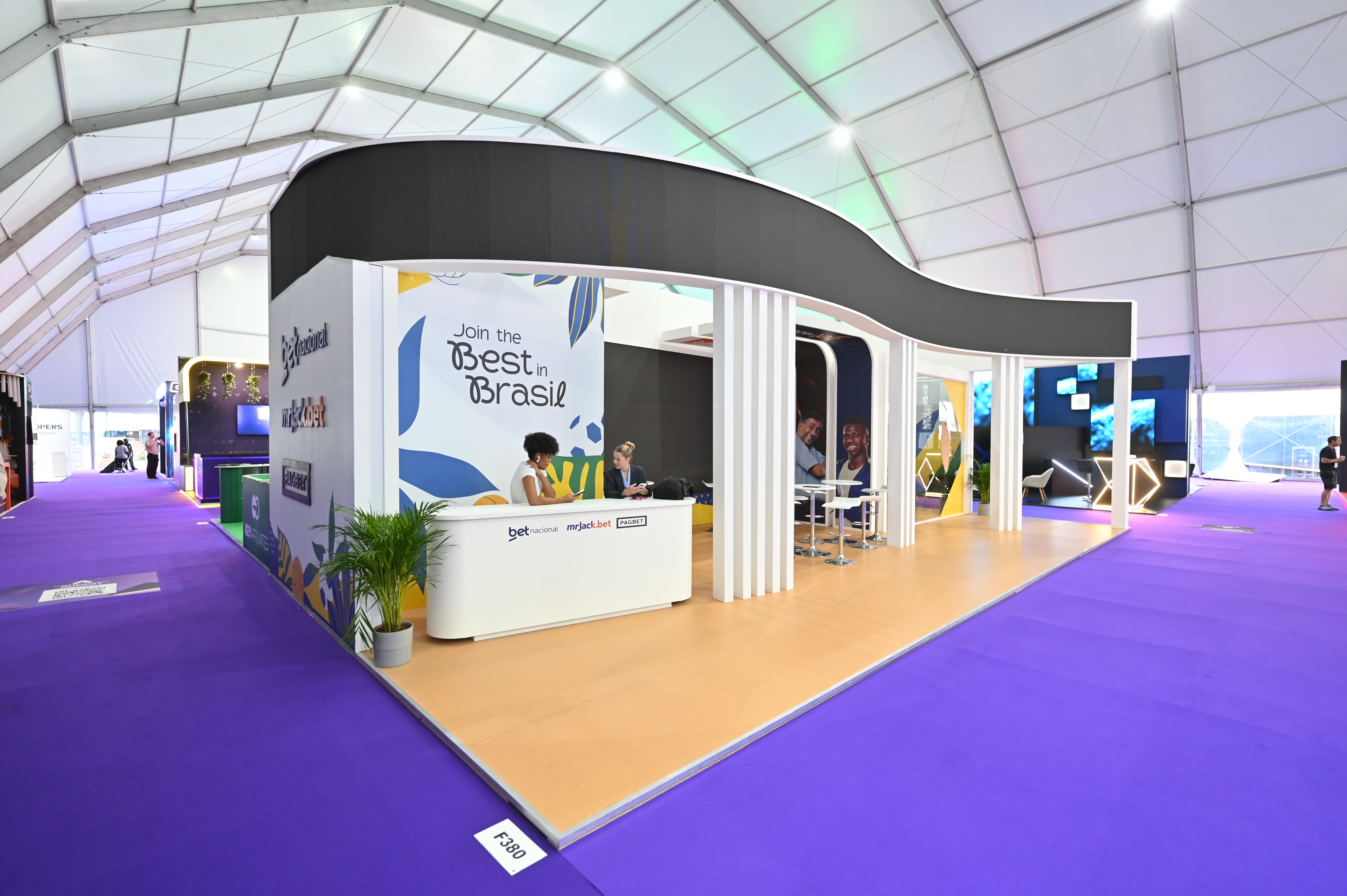
Between halls 1 & 2, 2 & 3 and 3 & 4
Stands located outdoors are exposed to external elements like wind and will be subject to inspection by a structural engineer and associated complex stand fees. Click here for Wind Resistance Inspection Fee
All stands between halls are situated under a roof or tent. Rigging and double-decker structures are not permitted in this area, due to the floor loading limits and roof structure. The stand design must account for the two pillars - 0.8 diameter - located around the central area. It is essential to remain within your allocated space and adhere to your designated square metres to avoid any encroachment on the surrounding pillars. This will ensure a cohesive layout and prevent any disruptions in the overall design of the area.
Uneven Flooring
Due to the irregularity of the flooring, caused by cobbled flooring throughout this outdoor area, it is strongly advised that exhibitors use a platform or raised floor for their stands (with a flexible wood base). Exhibitors are responsible for ensuring that their stand is securely constructed and does not pose a trip hazard or risk of instability.
Pillars - only applicable to 1 & 2 and 3 & 4
Stands between 1&2 and 3&4 have two pillars in the central area. Pillars around the area have a diameter of 0.8 metres. Any structures to be assembled must receive prior authorisation, with detailed plans submitted for review. See photos of pillars.
The DWG is available upon request. Please reach out to events@sbcgaming.com
Tent - only applicable to 2 & 3
An open sided tent will cover the space between Halls 2 and 3, with dimensions of 25m x 90m (height varies depending on location). Please note that the sides of the tent are approximately 2.5m high due to the supporting struts.
The back walls of your stand, if located under the tent's struts, are subject to a height restriction of 2.5m. Beyond the struts, the height allowance increases. The maximum permitted height for stands is 3.5m, provided there is a 0.5m clearance between the top of the stand structure and the roof of the tent. Click here to see dimensions of tent.